.png)

Our History

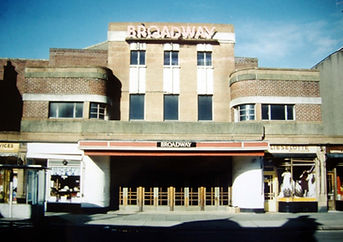
The Broadway Cinema opened on the 29th of April 1935 as Prestwick's new super cinema!
The Broadway brought the magic of film to the town during the golden age of cinema and stood as a pillar of the community for decades. Here we look back into the Broadway's past, from laying the foundations in the 1930s to laying new foundations in the present day.
Let's take a trip back in time, and step into the future!
CHAPTER ONE
Building the Broadway

A new wave of excitement rushed across Scotland from the 1920s to the 1930s as cinema took off as one of the premier forms of entertainment available across the world. Throughout Scotland, new custom-built cinemas were being constructed in almost every major town, often beautifully designed in the exceedingly popular architectural style of the time, Art Deco.
Prestwick Picture House had opened in 1920 as the town’s first purpose-built cinema, however greater plans were put in place in 1934 by the newly formed independent Prestwick Cinema Company Ltd. To design their new cathedral of film, they turned to London-born architect Alister Gladstone MacDonald.
Alister, although born in London, was the eldest son of Scottish politician James Ramsay MacDonald, who went on to become Britain’s first ever Labour prime minister, and Margaret Ethel Gladstone, prominent social reformer and Board member of the National Union of Women's Suffrage Societies.


Alister studied in America for many of his younger years, specifically studying skyscrapers and sound insulation design in New York and Hollywood, before returning to the UK to become the leading architect of newsreel cinemas in Britain. His most famous designs were at Victoria and Waterloo train stations in London, although sadly his plans for cinemas in Glasgow Central and Edinburgh Waverley stations never came to fruition. He also designed numerous cinemas for the Caledonian Associated Cinemas group in Scotland, including the Playhouses in Peebles, Montrose, and Elgin.
Come 1934, it was Prestwick’s turn. On the site the Broadway would be built stood a small homestead, Albert Cottage, which needed demolished to make way for the new super cinema. Astonishingly, from the date that planning permission was granted to the Broadway's grand opening ceremony, the time taken to build the Broadway was just 5 months and 27 days!

When it came to designing the Broadway, Alister MacDonald created a beautiful and symmetrical Art Deco façade design, with a recessed three storey tower as the central section flanked by two storey wings curving in to meet it. The front entrance features four sets of double doors beautifully glazed in Art Deco, set back from the street by a golden terrazzo floor.
The entrance is flanked by four shop units, two on each side, which also featured upon construction matching Art Deco glazing to the cinema itself. Shop units one and two still retain some of their original features including an identical ceiling design to the Broadway’s café. Shop unit two, now The Chocolate Box, is a special survivor with the original front door and glazing, this shop upon opening was originally a tobacconist!
The vertical central tower was built largely of reconstituted sandstone with two sets of three narrow window bays on both the first floor and second floor of the building, and at the top of the tower was a large wooden Broadway sign coloured in red and gold. In beautiful contrast to the sandstone of the central section, the wings of the façade and rear of the building were constructed from traditional red brick, with the windows on the wings curving in towards the central tower and featuring the same Art Deco glazing as the entrance doors below.


The interior of the Broadway continued the beautiful Art Deco theme of the façade to create a grand and special atmosphere throughout the cinema. The Broadway was designed with a pleasantly wide and deep foyer area, with the central dark wood octagonal ticket booth as the wonderful signature feature.
The voyage of discovery we have enjoyed during the preservation of the Broadway has revealed the foyer was originally divided in two, with the ticket booth surrounded by a second set of Art Deco doors to the rear of the foyer. We have also since discovered the original walls were bright gold, sparkling in the light shining from Art Deco light fittings, with dark wood panelling and chrome adorning the lower half of the walls.
Doors at the rear of the foyer led directly to the rear stalls of the auditorium, with the white terrazzo grand staircase sweeping up at the right to the balcony foyer above and a secondary staircase to the left that reached the very top of the auditorium.


The balcony foyer featured the same design as the main foyer below, with a neat sloped ceiling and main entrance doors to the auditorium balcony. It also featured a cleverly designed lightwell to the foyer below, so manager and patrons could stand and watch as the crowd swept in below them to the matinee. The lightwell was adjacent to the tea room and featured pleasant metal balustrades to prevent anyone falling into the void below!
The balcony foyer also featured restrooms, the manager’s office, the fire escape to the projection room and two routes of access to the tea room. The carpet in this area, the auditorium, and the tea room was a gloriously striking Art Deco design with waves of pink and gold! Vestibules hosted gold Lloyd Loom sofas with palm fronds and framed photographs adorning the golden walls.


The Broadway’s tea room was situated on the first floor above the main foyer, looking out on Main Street through the lower-level windows on the central tower. The tea room originally featured bright orange paintwork and luxurious wood panelling, Lloyd Loom furniture, and below the two internal windows on the wall adjacent to the balcony foyer’s lightwell there stood a faux fireplace. Above the fireplace there featured a Genalex mirrored clock flanked by Art Deco light fittings, and the clock still stands today!
At the north side there was a narrow kitchenette which featured uniquely a dumb waiter leading down to a main kitchen below, although this kitchen was not directly accessed by the cinema. The tea room’s catering was managed by the original sweetie shop of the cinema in shop unit one, operated by Prestwick institution James Gardiner, the shop had direct stair access up to the tea room and the dumb waiter provided passage for crockery to be exchanged in either direction!


The auditorium of the Broadway held 1,060 seats and featured upon opening a wonderful colour scheme of stone and flame with flashes of red and blue. In the centre of the ceiling there was a large rectangular trough feature that ran up to the screen opening and featured scalloped internal edges and recessed lighting. Framing the screen opening were two deep proscenium arches, rectangular and shining bright focusing attention on the centre of the screen.
Undoubtedly the most wonderfully unique and quirky details of the auditorium were six ceiling air vents designed with a camel motif! The stage of the auditorium was unusually wide and deep for a cinema of the Broadway’s size, 36 feet across and 16 feet deep, and featured direct access from the basement below, stage left and right.


The basement of the Broadway included changing rooms for ladies and gents, a workshop, a water tank room and a boiler room. The boiler of the Broadway was a Beeston Robin Hood ‘New C’ pattern oil burner and would have powered at the time what was a state-of-the-art heating system. The boiler is still in place today and the workshop beside it remains as a time capsule with endless amounts of spare parts and cinema-era relics.
Speaking of time capsules, undoubtedly the Broadway’s most remarkable survival is the projection room. Virtually untouched since the last film showed in 1976, the projection room remains as a journey back in time with the projectors, sound equipment, lighting controls and everything else needed to screen 35mm film still in place. The original projectors were Ross-London models, supplied by a ECC mercury arc rectifier. In 1956, this equipment was upgraded and the Broadway’s brand new projectors were fitted, Gaumont-Kalee Type 20s with an additional upgrade to the Western Electric sound system.


1956 also saw the Broadway introduce the latest wide-screen format Cinemascope for the first time, with the original side-opening curtains also being replaced by a festoon curtain that raised vertically to reveal the screen. Other items such as the spot projector, film reels, rewind cranks, record players and even the wall-mounted telephone still remain firmly in place. Remarkably, although lying in pieces the original ‘Broadway’ sign from the façade’s tower was also still stacked in the corner!
The Broadway officially opened on 29th April 1935, with a grand opening ceremony and packed crowds on Main Street. From the first film, The Barretts of Wimpole Street, the Broadway instantly became one of the region's premier picture houses.
The cinema with a charm all its own.

Chapter One photographs (chronological): The Broadway in 1935, Alister Gladstone MacDonald, original hand-drawn plans from 1934, original door handles, surviving terrazzo entrance floor, foyer dark wood panelling, the ticket booth, the remnants of the grand staircase, looking out the manager's office, the lightwell's metal balustrade design, the balcony foyer, the tea room, the tea room toilet doors, the auditorium's proscenium arches, one of the six camels, the balcony side-wall design, the original rewind bench, the in-situ Gaumont-Kalee projectors, Cinemascope masking controls, a fragment of record on a Western Electric record player, the original Chalmers spot projector with the rest of the projection room behind.
CHAPTER TWO
The Golden Age of Cinema

The Broadway remained the shining jewel in Prestwick’s crown from the 30s to the 50s in what was known as the golden age of cinema throughout the world.
Television was still rare to find in the homes of the working class until the mid 50s, and therefore one of the prime forms of entertainment at that time was to go to the pictures! Cinema provided an escape from day-to-day life, with the magic of film taking people of all ages on adventures into worlds unknown from their hometowns. The evocative design and atmosphere of so many beautiful Art Deco cinemas made a visit an occasion to be remembered, and the Broadway brought this wonderful experience to the people of Prestwick time and time again, creating memories that live on today. The Broadway became an integral part of our cultural heritage.

The golden age of cinema experience was radically different to the typical cinemagoing experience today. Rather than paying for a single screening and seeing one movie, visitors would typically watch two screenings! The 'B-feature' would be a short film, often a comedy or cartoon, and after ads, newsreels, and an intermission, the 'feature presentation' would follow later. If you perhaps missed the start of the film you could simply stay in your seat, and keep watching when the picture started again, leaving when you reached the scene you came in to!
And the cinema experience was not only the film itself, most cinemas had a café or tea room adjacent to the auditorium and a sweetie shop usually next door on the street. Bringing all these elements together truly made the cinema a day out for anyone, whether you visited with your family, a group of friends, or on a date!


Part of the success of cinema throughout the country was the affordability of it. Although the Broadway was the luxury cinema of the town, admission prices still ranged mostly between one and three shillings depending on your seat, in fact when the Broadway first opened you could get a seat in the front stalls for as little as 6 pence!
We know this from some fantastic finds in the Broadway’s managers office including multiple newspaper advertisements from different eras showing admission prices and daily return sheets showing profit, patron numbers and seating choices for individual screenings. There's even some wonderful comments from the manager explaining lower attendance numbers, such as the circus being in the town and bathing beauty competitions taking place at Prestwick Bathing Lake.
Of course, as is the case with any cinema, from the past or present, often the running of such a business comes with its difficulties and unfortunate events. A remarkable collection of surviving letters and documents was discovered by cinema historians Gordon Barr and Gary Painter in 2005, that paints a very vivid picture of how the Broadway operated at this time, with a wonderful variety of topics, including war-time ice cream shortages, break-ins, curtain cleaning, equipment replacements, and even patrons tearing their clothes on seats!


Most of the letters and documents were written and signed by the managing director of the Broadway at the time, Sir Alexander B. King. A giant of the cinema industry in Scotland, Sir Alexander managed several different cinemas between the 30s and 60s, and was knighted in 1944 for his charity work during World War II, in bringing moving cinema to displaced children in the rural communities of war-time Scotland. His correspondence was mostly between himself and the Broadway's managers including Fred Henderson and James C. Ross, as well as other directors and secretaries including original chairman J.C. Sword.
In the 40s, the Broadway hosted a trio of celebrity visits! In 1940, Scottish personality Sir Harry Lauder visited for a wartime charity concert with the Scottish Football Association. Wonderfully, Bob Hope also played on the Broadway's stage to American soldiers stationed at Prestwick Airport during the war! Then, in 1947, star of the film adaptation of Guys and Dolls, Vivian Blaine, visited to huge crowds on Main Street and a gala performance of 'You Made Me Love You' on stage to a piano accompaniment.


The Broadway not only showed film too, it’s position at the heart of Prestwick’s community was only strengthened by its usage for local events. Many residents today still remember attending the Broadway’s auditorium for school prize-giving shows, local music performances, and other community events.
Every Saturday morning in the Broadway and the other cinemas in the area, it was Children’s Day! Children could gain entry at a reduced cost to see any number of different films being shown, Westerns were a favourite here with the children often cheering the goodies and booing the baddies! One annual event in Prestwick that has since long ended was Prestwick Week, when a number of venues in town would offer free or reduced entry for residents of the town, the Broadway used to offer one free ticket for the children of Prestwick’s schools!


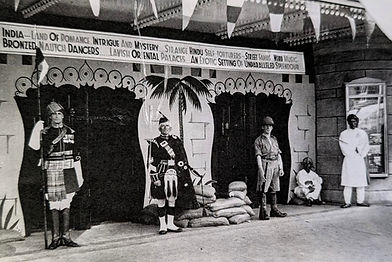
The art of golden age cinema showmanship was perhaps exhibited better than anywhere by the Broadway's first manager and impresario, Victor Gillgan. Each and every film the Broadway showed, Mr. Gillgan went to extraordinary lengths to theme the Broadway around them, in remarkable feats of marketing. These included displays of 'native haggis', a model sonic death ray, and live monkeys and alligators in the foyer!
The Broadway thrived during these early years, and was an integral part of the Prestwick community. Thankfully the echoes of glitz and glamour of the golden age of cinema still live on in the Broadway of today, and will endure for generations to come.

Chapter Two photographs (chronological): A Broadway programme from January 1945, the Broadway's auditorium in 1935, the cinema's entrance decorated for 1935 film 'The Lives of a Bengal Lancer' (display includes cultural appropriation unacceptable by today's standards), Sir Harry Lauder in the foyer with chairman J.C. Sword, managing director Sir Alexander B. King, and chairman of the Scottish Football Association in 1940, salvaged timetable of films headers, rediscovered Kia-Ora stand, original light fitting, tea room clock, Bob Hope who visited during WWII, Vivian Blaine who visited in 1947, inside pages of January 1945 programme, the projectionist's telephone, the projection room portholes on the rear balcony, and tea room pyramid design.
CHAPTER THREE
Transition to Bingo and the Final Film
Sadly, the glory days of the 30s to 50s were not to last for Scotland’s cinemas, including the Broadway. The rise of television meant that people no longer needed to leave their homes and visit the cinema to enjoy the magic of film. For many, of course, the cinema remained a very special experience and worth the visit as it still does today, however, the special status cinema held as the prime form of entertainment was to start fading away at the beginning of the 1960s, and the Broadway had to adapt in order to survive.
The Broadway, in particular, chose the same path at this time as did so many other cinemas in the area, and start a slow transition to bingo. As demand for cinema was decreasing, the demand for bingo halls was very much still strong, and the large auditorium of the Broadway was perfectly suited to play host to this role. The management at the Broadway chose this period of change to redecorate considerably, with the gold of the foyer switching to white with gold and pink flecks, the auditorium from stone to blue, and most drastically the foyer was altered by removing the second set of glass doors and moving the ticket booth to the stairs.


One document found in the building and saved for the archives was a programme from March 1964, and sadly alongside the classic films of Rio Bravo and From Russia With Love we can see already that several days a week were solely dedicated to bingo, a trend that would only continue in the coming years until the Broadway Bingo and Social Club became the sole operation in 1966.
However, there was yet to be a film revival! The Broadway wasn’t yet done with the big screen and in the mid 1970s, after many other cinemas in the area had already ceased to exist, the Broadway gave cinema one last go by bringing back screenings. The revival was pioneered by Mr. John Sword, the grandson of the first chairman of the Broadway, Mr. J.C. Sword.
Full-time film returned with a double-bill of Young Frankenstein and Emperor of the North on 1st March 1976, and from here the Broadway's programme became very experimental! Despite initial claims the cinema would focus on family-friendly films, 'X' certificates soon crept in, with one best-selling highlight being the infamous Emmanuelle, the only film the Broadway played before the big chains as the others refused to play it!

Other highlights of the returning programme included double-bills of Bullitt and Blazing Saddles, a Bond special of the Man with the Golden Gun and Live and Let Die, and the iconic titles of the Poseidon Adventure the Towering Inferno, and the Exorcist. However, it was the struggle to compete with the nearby ODEON and Orient in Ayr in obtaining films first that proved a step too far for the Broadway in '76. As a result, the revival lasted for ten months. Despite the Sword family’s best efforts and great effort expended, in the long run the cinema just couldn’t remain profitable. The Broadway showed its last film, One Flew Over the Cuckoo’s Nest, on 20th November 1976.
The projectionist turned off the projectors and gave them one last service, hoping that one day they might roar to life once again.

Chapter Three photographs (chronological): The Broadway in 1960 just before bingo would be introduced to the programme, the repainted speckled walls of the foyer with evidence of the original gold, the ticket booth moved to its current position on the steps, the projectors dormant since the final film finished, and the Sword family in the balcony foyer to celebrate the return of film in March 1976.
CHAPTER FOUR
Amusements and Squash

With the end of cinema, the Broadway’s future was destined to take a different path. By 1981, the building had been sold and had since reopened as the newly named Broadway Leisure Centre, subsequently renamed Prestwick Leisure Centre.
The building was bought by a Mr. Sheeran and family, and their takeover resulted in significant changes to the Broadway’s appearance both inside and out. Sadly, at this time the façade of the building was greatly simplified, with an outer concrete render added to the majority of the frontage, covering the original red brick and recessed stone, and also the upper level windows. The ground level of the building was completely redeveloped, the front foyer was transformed into an amusement arcade, false wall and ceiling panelling were erected, and the grand staircase to the balcony foyer above was blocked off.


The quirkiest additions were LED lights with aircraft photographs in front, that remarkably came to the Broadway from London Heathrow! The rear stalls were also walled off from the rest of the auditorium, as this area was repurposed into a pool and billiard room, to act as an extension of the amusement arcade at the front. Thankfully, some original features remained, including the original ticket booth!
The second half of the new Leisure Centre was to be created at the rear of the building in the former auditorium. Most destructively of all unfortunately, this meant that all seating needed to be removed, and the original proscenium, stage, and front circle was cut into and destroyed to make way for the new changes. The original raked floor was levelled to make way for three championship standard squash courts built to cater to all skill levels of the sport as well as a luxury gymnasium, all under new suspended false ceilings, hiding the upper levels of the auditorium from view. The centre also featured shower rooms and a carpeted lounge area to the side of the courts.


Among the favourites of the amusement arcade at the front were the classic arcade games Space Invaders and Pac-Man, with the last remaining machine, the Grand Canyon penny falls game, still dormant in the building until 2022. The Leisure Centre often had a rough reputation, with no loitering signs out front, and orders from parents to stay away! Despite this, many still hold fond memories of the amusements and squash courts today. The courts too were often used for events other than squash, such as keep fit classes, dance classes, and even an indoor market.
Later added to the amusement arcade at the front was a new internet café, introduced once the internet became usable and accessible at the turn of the century. Thankfully, with the upper levels of the building falling out of public use at this time, that meant that cinema era items could survive untouched, specifically in the projection room!
The Broadway would remain as the Leisure Centre until being sold to Buzzworks Group in 2003.

Chapter Four photographs (chronological): The Broadway Leisure Centre in the 1980s, the scale of the squash courts from below with the original cinema auditorium above, the payment system for the squash courts, the courts before demolition in 2025, the Leisure Centre in 1999, the old entrance to Prestwick Squash Club at the rear of the auditorium in the former car park.
CHAPTER FIVE
The Broadway Cinema Experience

When Buzzworks purchased the building in 2003, they had plans to redevelop the Broadway again as a boutique hotel, however these plans never came to fruition. Therefore, for 20 years the Broadway stood silent. Until the introduction of Friends of the Broadway Prestwick. Our group was founded in 2012 by local couple and lifetime friends of the project Colin and Leica Malkin, with the aim of purchasing the building and reopening the Broadway Cinema once again.
It has been a long journey since then!
The project has seen multiple different iterations take shape over time. From a town charrette in 2016 to a first feasibility study in 2018, a first film festival in 2019 to a full project relaunch in 2021. Post-pandemic, we took the project back to the brickwork and reevaluated the direction in which our community wished us to travel, what we could preserve from the Broadway in its current condition, and what change was needed to make that progress a reality.


First, we needed to establish a critical piece of information, and we got the news we were hoping for. Contrary to previous advice, we confirmed that the Broadway's original auditorium structure could be saved! This set the ball rolling for an all-new project outlook with heritage preservation at the forefront of everything we hope to accomplish.
With Buzzworks' support, we got keys to the building and were able to document just how incredible a survivor the Broadway is, and the wonderful original features and atmosphere that you can still see and feel to this day. We were then able to immediately implement temporary measures to slow the rate of deterioration in the building, and safeguard the future of the structure. in 2023, we signed a licence to occupy the building officially for the first time, and in 2024 on the cinema's 89th anniversary we made history by purchasing the Broadway and bringing it into community ownership for the first time with funding from the Scottish Land Fund.


To deliver our community's vision for the Broadway of the future we partnered with the UK's leading architects of heritage cinema and theatre restoration, Burrell Foley Fischer, with managing director Faye Davies becoming the lead architect of the Broadway's restoration for the future.
Additional funding was obtained to undertake extensive essential maintenance on the building including temporary roof repairs, improvements to the building's security and risk management, and most impactfully the removal of the squash courts to reveal our original auditorium for the first time in over 40 years.
We partnered with our local high school, Prestwick Academy, with the founding of an Academy Board of Directors, a student committee formed by the senior captains of the school. Our Academy Board have participated in major Broadway events, architectural design workshops, and the first 35mm projection workshops to take place in the building.


We cemented the preservation of the art of film projection at the heart of the project's development with the salvage of various projectors and projection equipment from other cinemas across Scotland. The skills and knowledge of historic film presentation will be continuously passed on to younger generations, from the first demonstrations on restored kit at community open days to curated workshops to deliver hands-on experience.
This initiative, and the early success of the partnership with Prestwick Academy, led to the foundation of the Broadway Youth Film Society in 2025. The society was formed to deliver powerful learning opportunities in not only the presentation of film but the film-making process too, with workshops delivered with our new media partner, Ayrshire Film Company. From the first branch in Prestwick, the society has now expanded to additional schools throughout South Ayrshire, with a full course in analogue projection currently in the development stages.


Rewinding to 2023, our pop-up cinema events have played an enormous role in the growth of our project and our membership base.
From early beginnings at smaller community venues, we graduated to Prestwick Academy with the first screenings of 'new releases' since the Broadway's closure, new film festivals, and festive specials. With the support of Indy Cinema Group for the programming and delivery, we were able to enjoy powerful audience development opportunities through the return of film to Prestwick after half a century away.


Our restoration of various 35mm projectors led to an appearance on national television, with the Broadway featuring on Series 2 of the BBC's Repair Shop on the Road programme.
This incredible opportunity was made possible by restoration expert and host Mark Stuckey, and with the support of former projectionist Steve Rowley and the Broadway's own house engineer Keith, our surviving Gaumont-Kalee projectors and Western Electric sound system were restored to working condition. This astonishing achievement has ensured the Broadway now hosts the only operational carbon arc projectors in Western Europe!
Calling his experience the best he has had in his television career, we were delighted to subsequently announce Mark Stuckey as a patron of the project.


Our aims to preserve cinema heritage also extend far beyond projection, with an array of artefacts and memorabilia both discovered and saved from the Broadway, and several other Scottish cinemas still standing in various forms.
This led to the formation of an extensive heritage collection at the Broadway, and a wider long-term aim to preserve our nation's collective memory of cinemagoing, immortalised in the best preserved golden age cinema in the country. This heritage collection was the inspiration to open up the Broadway's auditorium to the public for the first time since 1976, with the creation of the Broadway Cinema Experience.
A team of volunteers led out on the primary attraction of this new visitor experience for Ayrshire, the Broadway Pop-Up Museum.


The Pop-Up Museum immerses visitors in the history of the golden age of cinema and the Broadway's place within it, with a volunteer-built projection island and workshop delivering film back on the Broadway's big screen and engaging learning opportunities with projection equipment and items currently being restored.
One highlight of the new visitor experience, and a major coup for the project's future, was the arrival of our very own Broadway Wurlitzer cinema organ. Originally installed at the Ritz Cinema in Luton and donated to the Broadway for installation during the building's restoration, the Wurlitzer acts as a one-person orchestra and its arrival has made the Broadway the only Scottish cinema to host a cinema organ.
We have since added a second smaller Compton organ, that has been digitally remastered to play any sound through any sound system, opening up the opportunity for performances before the Wurlitzer's installation is complete.


We are now aiming to expand the Broadway Cinema Experience programme as part of our first phase of operations. The return of feature films and introduction of live music, theatre, poetry, and presentations, are all now imminent as we aim to ensure the Broadway becomes a cultural hub for our region even in these early stages of semi-dereliction. All the while creating a wonderfully immersive and unique experience for visitors witnessing a cathedral of film frozen of time from the glitz and glamour of the golden age of cinema.
It is an incredibly exciting time to follow the project and we would love for you to join us and visit us! You can become a member of the Broadway for just £15 a year or £2 a month and gain access to a wide range of exclusive benefits including a member-exclusive event programme, a subscription to our bi-monthly magazine the Broadway Bugle, and more.
You can also book now to visit the Broadway by clicking the button below. We can't wait to welcome you, and we can't wait to see what the future holds.

Chapter Five photographs (chronological): The Automaticket machine in the ticket booth, the Broadway in 2026, projector one in our original projection room, decayed section of the auditorium's proscenium, the first Academy Board 35mm projection workshop, the Broadway's house engineer Keith, the Broadway's heritage ambassador Kyle, our first restored Cinemeccanica Victoria 5 projector in action, a Varamorph lens on the front of our on-display Gaumont-Kalee Type 20 in the foyer, an old Premier film reel, Oppenheimer showing at the Broadway Pop-Up Cinema Roadshow at Prestwick Academy, volunteers ushering patrons to their seats, our chief projectionist Guy with Fraser from Indy Cinema Group, Stephen Rowley and Mark Stuckey during our Repair Shop on the Road filming, our team with guests and film crew on the final day of the Repair Shop visit, the Broadway Pop-Up Museum, the foyer of the visitor experience, a Kia-Ora stand being assessed by the collections team, our Wurlitzer cinema organ, Guy in projection island, the audience awaiting our first hi-fi listening session, the GK20 projector in the foyer, a film rewinding in projection island.

.png)